


To
order Hitler Sites ($55)
click here
 German newsreel film: Rapturous crowds greet Hitler on
Speer balcony of Old Reich
Chancellery after his triumphant return by train from France, July 6, 1940. Reichsmarschall
Hermann Göring stands next to Hitler.
German newsreel film: Rapturous crowds greet Hitler on
Speer balcony of Old Reich
Chancellery after his triumphant return by train from France, July 6, 1940. Reichsmarschall
Hermann Göring stands next to Hitler.
Launch Real Player
This option requires Real Player.
Click here to download Real Player
Launch
Windows Media Player
This option requires Microsoft's Windows Media Player.
Click
here to download Windows Media Player
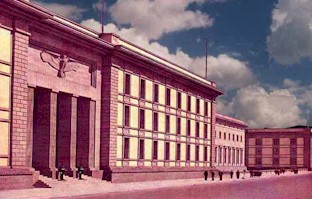
In 1945-46, the Russians obtained the marble for their
Berlin war memorial from the ruins of Hitler's New Reich Chancellery, on the
corner of Wilhelmstraße and Voßstraße, which Albert Speer designed and finished
in 1939.
Hitler had airily told Speer that the Old Reich Chancellery was “fit for a soap
company.” Located at Wilhelmstraße 77, the old chancellery had been built
1736-1739 as a palace for Count von Schulenburg. Otto von Bismarck remodeled the
building as his chancellery.
 Hitler decreed that the enormous New Reich Chancellery should impress every
visitor with its monumentality. “On the long corridor from the entrance to the
reception hall, they’ll learn something about the grandeur of the German Reich,”
said the Führer. The long corridor was 300 meters, with a court of honor, a
forecourt, a mosaic hall, a round hall, and a marble gallery along the way. At
146 meters, the reception hall was twice as long as the hall of mirrors at
Versailles. Hitler’s own office was 400 meters square. From the exterior, the
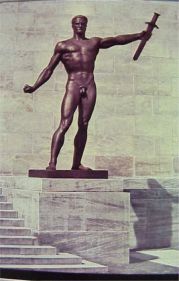
Reich Chancellery had a stern, authoritarian appearance; Arno Breker's statue of
a muscular, nude sword-bearer, "Army," stood to the right of the honor
courtyard entrance. The
chancellery interior had an
ascetic, cool splendor. Only German wood and marble were used in the building.
Many of the couches were so heavy that four men were required to lift them. The
East Germans began demolishing the bombed out chancellery in 1949, and didn’t
finish until 1956.
Hitler decreed that the enormous New Reich Chancellery should impress every
visitor with its monumentality. “On the long corridor from the entrance to the
reception hall, they’ll learn something about the grandeur of the German Reich,”
said the Führer. The long corridor was 300 meters, with a court of honor, a
forecourt, a mosaic hall, a round hall, and a marble gallery along the way. At
146 meters, the reception hall was twice as long as the hall of mirrors at
Versailles. Hitler’s own office was 400 meters square. From the exterior, the
Reich Chancellery had a stern, authoritarian appearance; Arno Breker's statue of
a muscular, nude sword-bearer, "Army," stood to the right of the honor
courtyard entrance. The
chancellery interior had an
ascetic, cool splendor. Only German wood and marble were used in the building.
Many of the couches were so heavy that four men were required to lift them. The
East Germans began demolishing the bombed out chancellery in 1949, and didn’t
finish until 1956.
Chancellery marble was incorporated into the Mohrenstraße subway station.
Authorities are divided over whether the red marble in the foyer of Humboldt
University came from the Chancellery.
Before 1933, the land under the New Reich Chancellery belonged to Jewish
department store magnate Georg Wertheim. The Nazis coerced Wertheim to dispose
of his Berlin property. The Wertheim family is now trying to recover this land,
but the German government, the present owner, does not want to give it up.

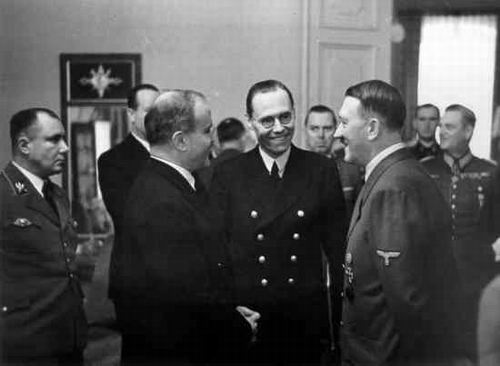
Video: German Foreign Minister Joachim von Ribbentrop receives Soviet Foreign
Minister V. M.
Molotov at the Anhalter Bahnhof, November 12, 1940. Molotov is driven to the New
Reich Chancellery, where he confers with Hitler; the sharp interchanges between
the two men hardened Hitler's resolution to attack the Soviet Union. "Hitler
clasped me with one hand when our picture was being taken," Molotov told an
interviewer many years later. "I was asked in Canada in 1942 why I was smiling
in that picture. Simply because they got nothing from us and never would!"
Launch Real Player
Launch
Windows Media Player
German newsreel film: Crowds greet Hitler in
Wilhelmstraße entrance courtyard of the Old
Reich Chancellery on the morning of his 50th birthday, April 20th, 1939.
Launch Real Player
Launch
Windows Media Player